 Sideline Legacy
Your league is in real cities now.
New leagues are built on real American cities, 383 of them in the catalog, so you might take over a club in Chicago or one in Sioux City. The clubs themselves are still made up. The nicknames, emblems, owners and history are all fictional, and so are the players. It’s the same city list behind the team generator. A bigger metro comes up more often, but each league draws its own set, so the map changes from one league to the next.
A league takes each city name once. Portland, Springfield and Columbus all belong to more than one real city, and the standings print a city without its state.
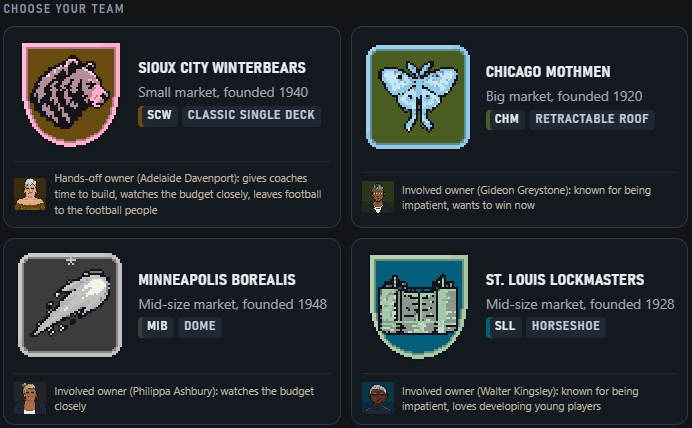
Picking a club in a new league.
Work in progress.
View full size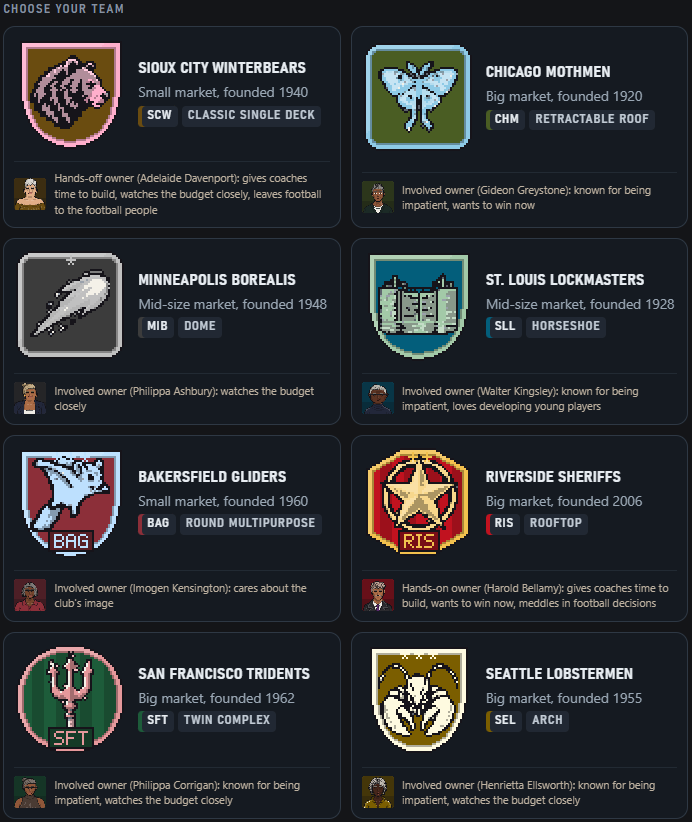
Real places meant the names had to make sense. Early leagues had the Chicago Mountain Goats, and the Bullhead City Blizzards in the Arizona desert. Now a nickname that claims something about a place needs that place to have it. That changed 537 of 9,600 clubs across 300 test leagues. Loose fits are still allowed. The Rochester Yetis are fine.
Divisions were next. The first version cut the map into even pieces and put a compass word on each one, which put Las Vegas in one Northwest division and Memphis in another. In a 32-club league the game now groups the closest clubs and names each division for where it is: Pacific, Gulf, Midwest, New England, Texas. It isn’t perfect. Four clubs to a division means the thin parts of the map get stretched, and about one club in five is still closer to another division than its own. It was nearly three in ten before.
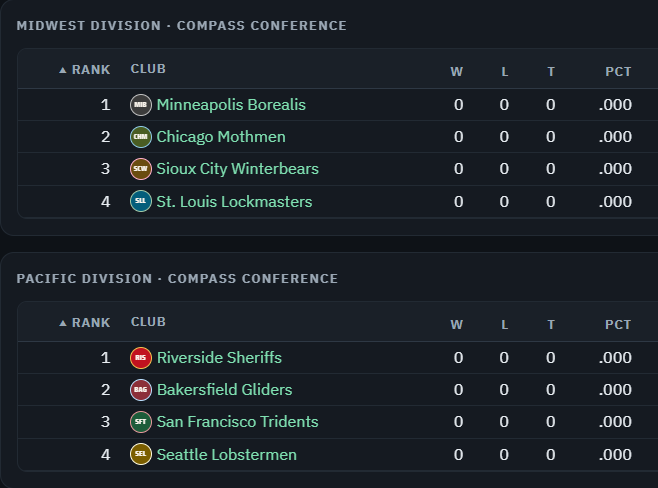
Two divisions in a new league, named for where they are.
Work in progress.
View full size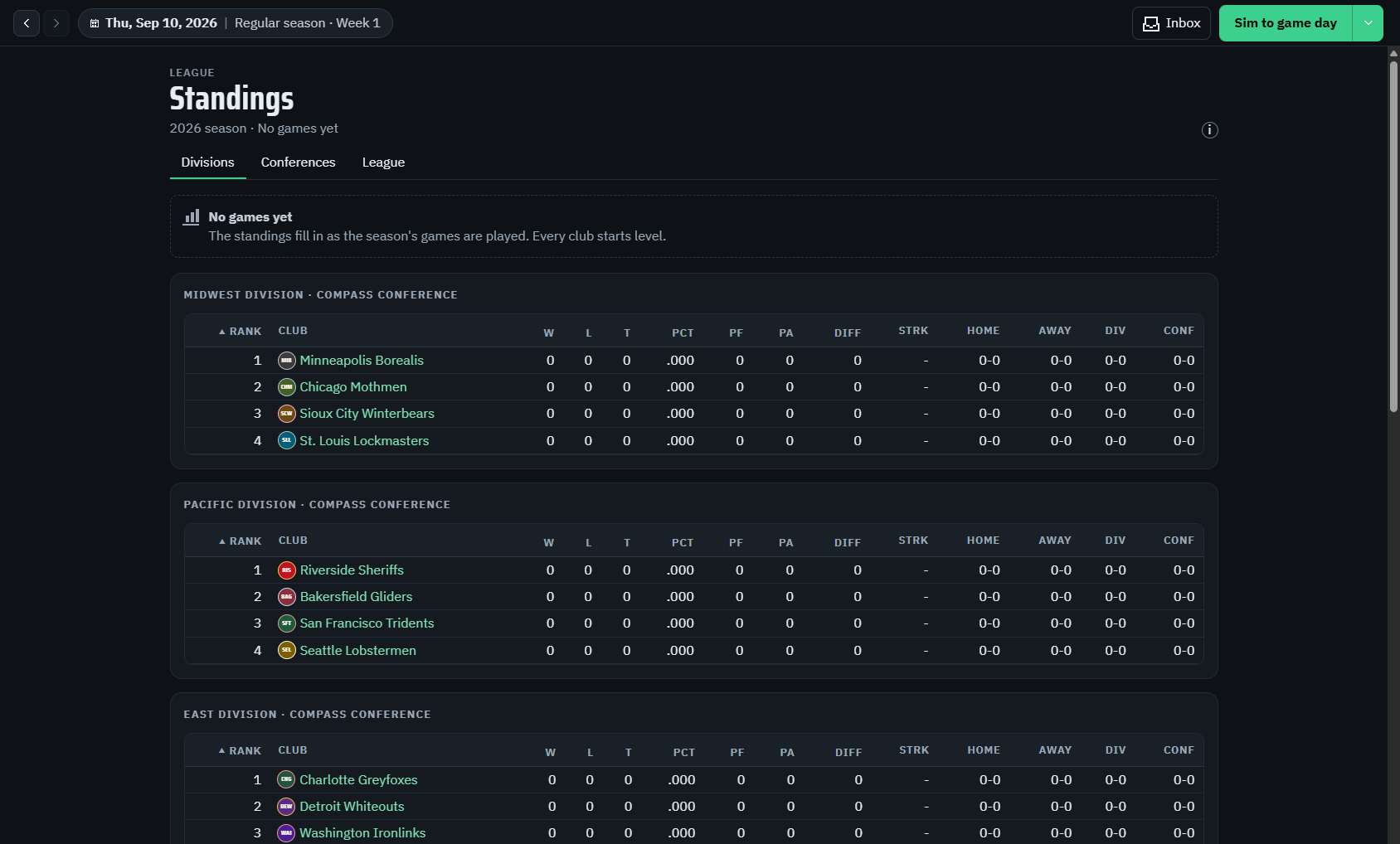
The other big job was finishing a list. I keep a list of 48 decisions a football player could make during a play. On November 2, 11 of them weren’t in the game. Now none are waiting: 33 are tendencies the engine plays, nine are covered by another tendency or a trait, and six are the coach’s call instead of the player’s.
Take a running back with a tackler about to meet him from the front. He can try to make him miss, which gives up ground and leans on his cuts and vision, or he can lower his pads, which leans on his size and speed and means taking the hit head-on. He can favor the stiff-arm or the juke and spin. Once he’s made the marker he can go down before the hit, or fight for more yards while more tacklers arrive and go for the ball. The card tells you what each choice gets him and what it costs.
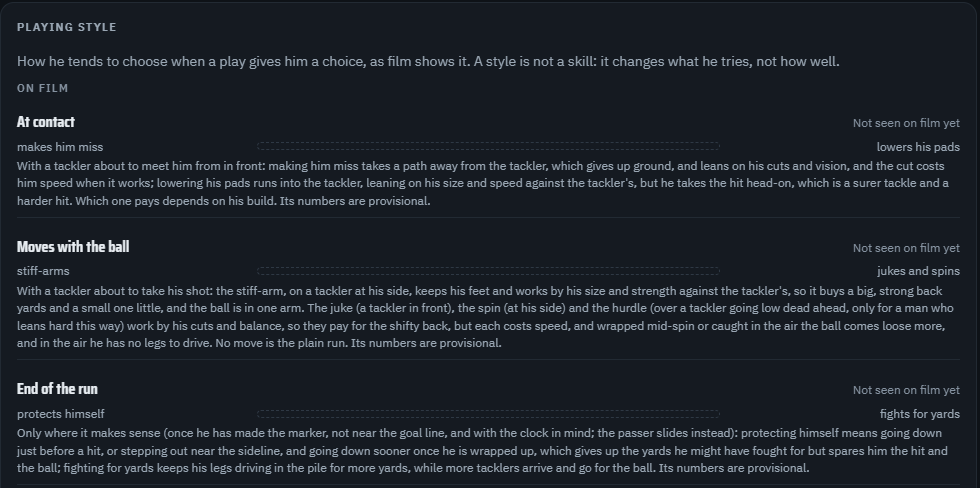
A running back's card: what each choice gets him and what it costs.
Work in progress.
View full size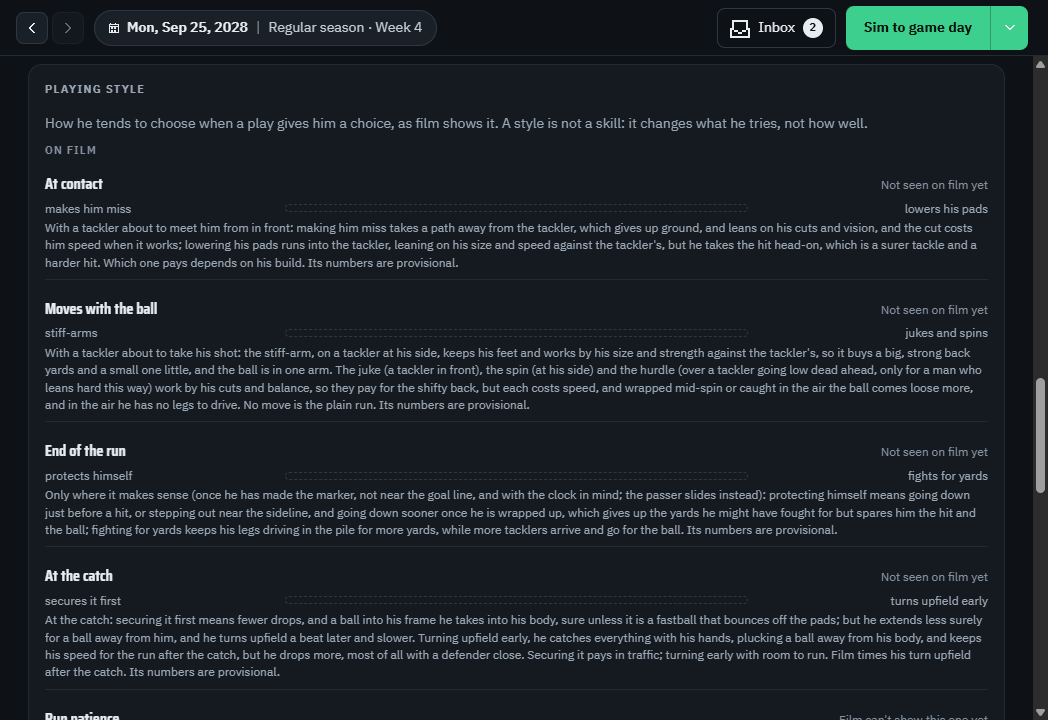
Defenders got the same treatment. The big hit stops a man where he’s hit and jars the ball loose more often. It also needs a run at him, misses more in an even matchup, costs both men more injuries, and can draw a flag on a receiver still securing the catch. A smaller hitter bounces off a big back. Going for the ball gets you more fumbles, and more broken tackles and yards after contact.
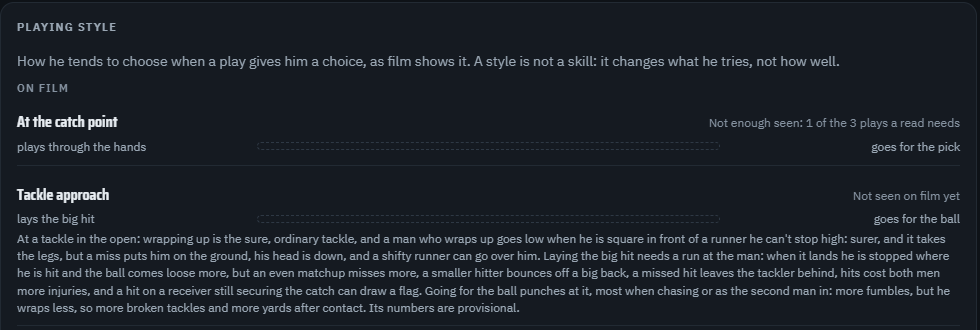
A linebacker's card: the big hit, the wrap-up or the ball.
Work in progress.
View full size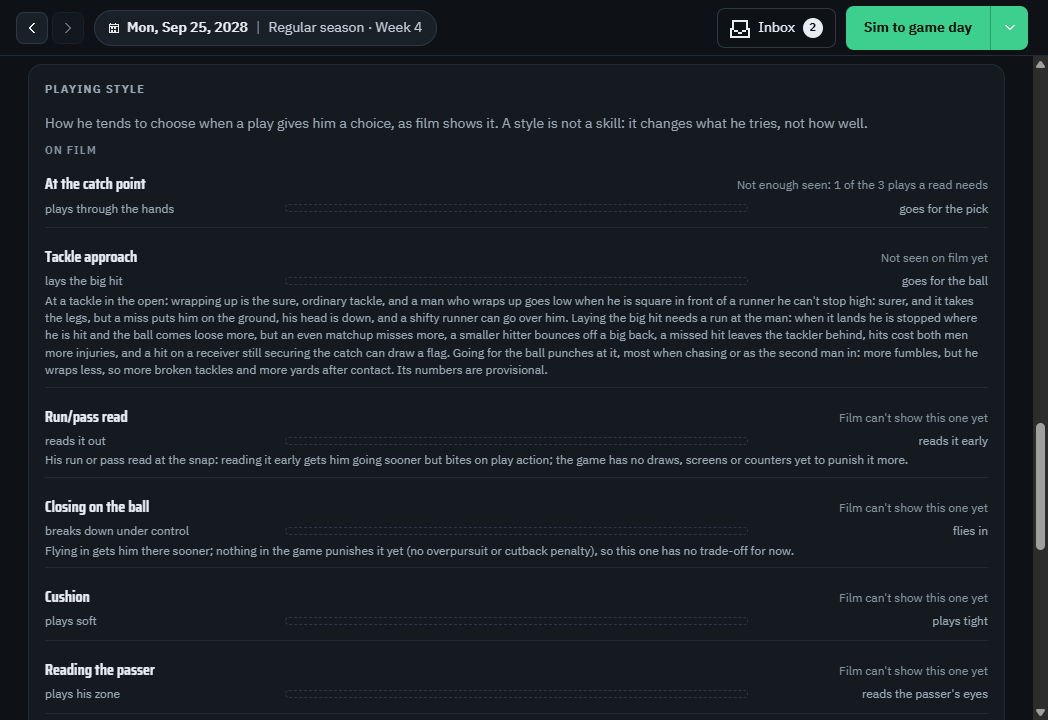
The hurdle came out of that work. I added a low tackle for a man square in front of a runner he can’t stop high. It’s surer and it takes the legs, but a miss leaves him on the ground with his head down, and that gave a shifty runner something to go over. In 24 normal games with nothing set up, runners hurdled 21 times. In a controlled test a shifty back who leaned all the way into it gained 2.92 yards a carry against 2.53. A back with no cuts lost ground.
Receivers now box out or high-point a contested ball. Linemen take a deep set or a jump-set. Corners mirror a man or get their hands on him. Kickers and punters go controlled or demanding. Pass rushers win quick with a swim or a long-arm, or win with power using a rip or a bull, and they show why none of this is simply better or worse. Power rushers got more sacks in career games, 10.7% of dropbacks against 6.6%, and won on third and long. Quick rushers gave up about a yard less a dropback. That’s a trade-off, so I left it alone.
Eighteen of the 33 show up on film, and the CPU staffs coach from it too. The other 15 don’t yet, and the card says so. The numbers on the new ones are provisional, and the card says that as well.
Run defense got one real fix. If you keep running the same inside play, a defense that has scouted it now stops it more often. Before, scouting it did nothing, because a defensive back in man on a back or tight end played the run like a deep safety, so the extra man in the box wasn’t really there. Now he fills. In the test the repeated run worked 29% of the time instead of 37%, and went from 4.01 yards a play to 2.58.
Two smaller ones. Once you make a promise in the press room, later questions stop offering it, and you get “I said what I said. Hold me to it.” in its place. And at halftime, “Ride the starters” and “Keep them fresh” now reach your staff’s substitutions. Before, if the staff was running your routine snaps, it rested tired starters at its own limit whatever you chose.
The football isn’t finished. I check the game against real pro football numbers, and nine of the 27 I hold it to are off. The biggest miss is big passing plays: 4.9% of throws gain 20 yards or more, and the target is 8.9%. Quarterbacks throw deep less than half as often as they should, and long runs tend to stop around 15 yards. Injuries look about 50% too common, with too few long ones. I tried some single changes on a throwaway copy and none of them fixed it, and the tackling change moved some numbers the wrong way. That needs a real round of work on passing and tackling, and it hasn’t started yet.
For how the whole league fits together, there’s the league page. If you’d rather find your own division by playing, the playtest list hears about tests before anybody else.